
Discreet unmarked vehicles on every visit
Pharaoh ant control in London
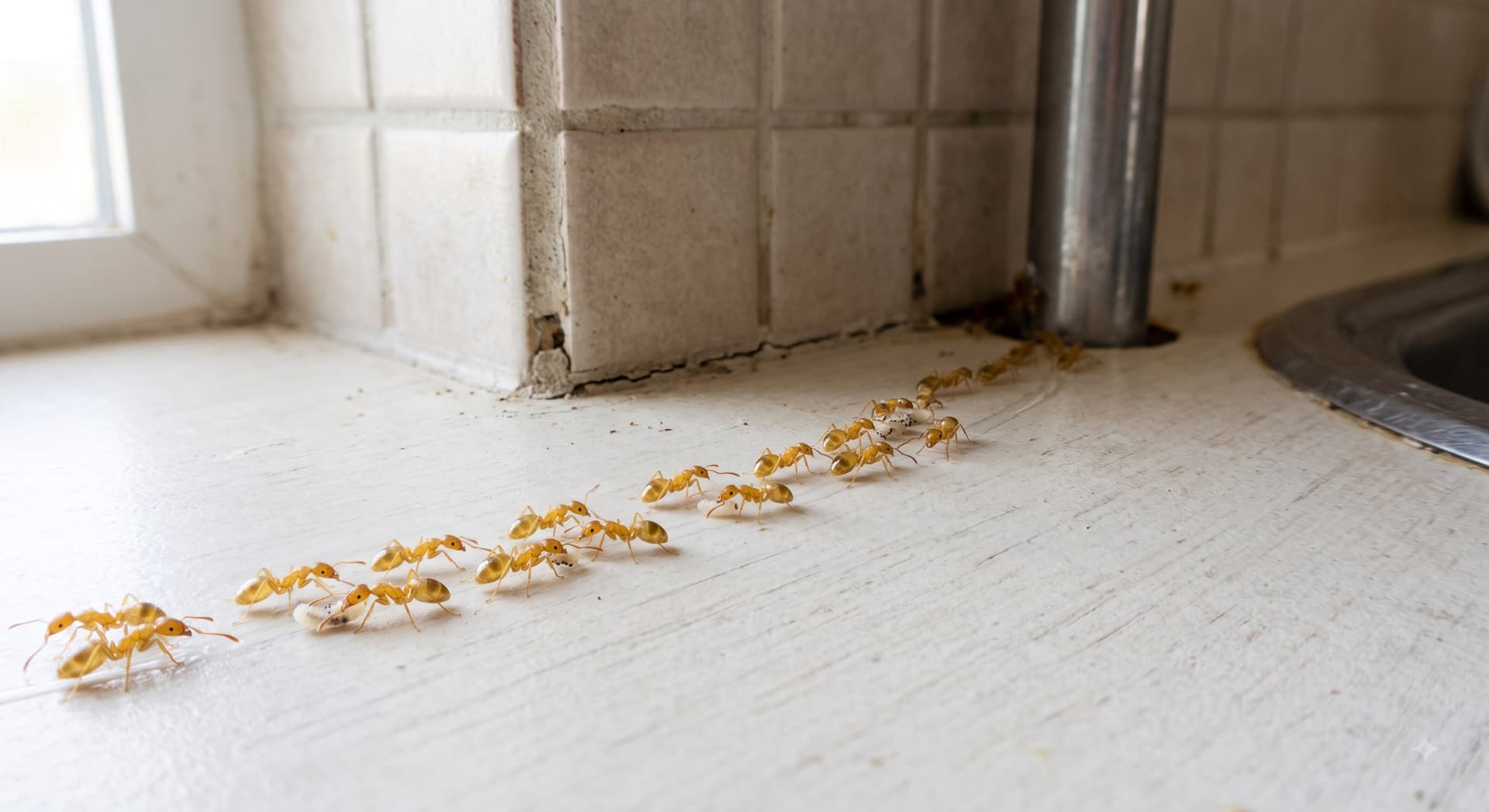
Tiny yellow ants in the bathroom, a thin chain of them along the kitchen tiles, and more of them a week after you sprayed: that is how most of London meets the pharaoh ant. Our pharaoh ant control in London is a surveyed gel baiting programme coordinated across every flat that has them, often same day Monday to Saturday, with a written six-month guarantee, subject to the site survey.
- Checkatrade approved
- DBS checked staff
- RSPH Level 2 certified
- Fully insured
- Six-month guarantee
In short
How pharaoh ants treatment works
Pharaoh ant treatment works by bait alone. Workers are under 2 mm and only 5 to 10% of a colony forages, so the trail you see is a fraction of a nest with many queens. Professional-use gel bait goes on every trail and warm spot the survey finds; foragers carry it back to the queens and brood and the nest collapses from inside. Nothing is sprayed, because a sprayed colony buds into several. The BPCA's technical manager puts surveyed gel baiting at two or three weeks, against around four months for a hormone bait.
Every treatment carries a written six-month guarantee, subject to the site survey. If the treated pest returns inside the six months, we come back and re-treat at no charge.
Signs to look for
Do you have a problem?
- Tiny yellow or yellow-brown ants, under 2 mm, in a bathroom, airing cupboard or kitchen
- Long thin chains of ants across tiles, worktops, cupboard shelves and kitchen fittings
- Trails that follow warmth: hot water pipes, the boiler, behind the fridge, a radiator
- Ants in more than one room, or in neighbouring flats, at the same time
- More trails, not fewer, a week after a shop spray
Not certain? Send us a photo — we identify it before you commit to anything.
Our process
What a visit involves
Building-wide survey
We trace every trail to its warm source, check adjoining flats and risers, and map every active point before any bait goes down.
Species check
Under 2 mm, yellow-brown, in chains, in a heated building: pharaoh. Ghost and Roger's ants take a different bait.
Gel baiting
Professional-use gel at every active point at once, applied strictly to the HSE-authorised label. No sprays, foggers or dusts.
Follow-up
Four to six weeks on, bait is checked and refreshed; councils run two or three visits on this spacing.
Sign-off
Clear across every treated unit before the written guarantee, with a report for the managing agent.
Gel bait or hormone bait, and why spraying makes pharaoh ants worse
A pharaoh ant colony has many queens, each able to lay up to 350 eggs a week according to Redbridge Council. The BPCA puts the risk plainly: when threatened, workers may bud, moving pupae and larvae away from the original colony, which can spread the infestation through a building.
- Spray, fogger or dust on a trail: kills the foragers in reach and triggers budding, so one nest becomes several. We do not use them on pharaoh ants.
- Hormone (insect growth regulator) bait: sterilises the queens and stops larvae developing, but the BPCA's technical manager says control this way can take around four months.
- Surveyed gel baiting: a professional-use gel on every active point a proper survey finds; the same BPCA source says control can be achieved within two or three weeks.
Garden, ghost and Roger's ants are covered on our ant control page.
What affects the cost of pharaoh ant treatment in London
The number of flats or rooms with active trails is the main driver, because every active point has to be baited at the same time or the colony moves. After that: the follow-up visits the programme needs (two or three is the council norm) and whether a managing agent or care home needs reports and a block-wide plan.
Lewisham Council charges £186 for up to three visits from 1 April 2026 and Wandsworth Council £214 for tropical ants, three treatments, from 1 April 2026; Hammersmith and Fulham lists £167 for two visits, Hounslow £210 and Brent £287 at October 2026. Our council guide compares boroughs.
The inspection survey is free, the quote is fixed and written for the whole programme, follow-ups included, and there is no call-out fee. Every treatment carries a written six-month guarantee, subject to the site survey.
Preparing for the visit and what happens after
Before we arrive:
- Stop spraying: shop sprays, foggers and powders split the colony, and the visible trail is where the bait goes
- Note every room and flat where you have seen them; in a block, tell the managing agent so neighbours can be surveyed too
After the visit:
- Gel bait needs no vacate time and nothing is sprayed
- Do not clean the bait points away: Redbridge Council's programme puts this rule first, and it is the commonest reason a treatment stalls
- Expect a noticeable reduction within about 28 days, the council benchmark; with gel on a well-surveyed site the BPCA figure is two to three weeks
- Larger ants appearing late in the programme is a good sign: the workers have gone and the queens are out foraging
- The follow-up is four to six weeks on; if ants persist four weeks after the final visit, we come back under the guarantee
Who is responsible for pharaoh ants: tenants, landlords, blocks and the law
In a block the freeholder or managing agent usually ends up responsible in practice, because the colony moves between flats. Shelter's guidance says a landlord must deal with pests let in by a repair they should fix or present at the start of the tenancy, and must keep the home fit to live in, the duty behind the Homes (Fitness for Human Habitation) Act 2018; a tenant is responsible only if their own conduct brought them in.
Pharaoh ants in a block are a domestic hygiene hazard under the Housing Act 2004 HHSRS, and the council must act on a Category 1 hazard. Awaab's Law is due to reach pests for social landlords in 2027, with a consultation on private tenancies open until 18 December 2026.
In healthcare and care homes, CQC Regulation 15 requires premises to be clean, suitable and properly maintained, and Redbridge warns that pharaoh ants may invade surgical dressings and spread infection between patients. Food businesses must have adequate pest procedures under Regulation 852/2004.
Where in London we treat pharaoh ants
Pharaoh ants are a heated-building ant: the BPCA finds them only in the structures of large centrally heated buildings such as high-rise flats, hospitals and bakeries, often around boiler rooms and ovens. In our area that means the post-war estates and mansion blocks of Westminster and Pimlico, the heated towers of Camden and the new-build developments along the river in Battersea and Wandsworth, where shared risers keep a colony at breeding temperature all year.
Hospitals, care homes and bakeries in Hammersmith, Hounslow and the TW postcodes get the same programme with the reporting their regulator expects. A single house in Richmond or Wimbledon is rarer; the survey still covers the whole building. Our post on tiny yellow ants in London blocks has more.
Reviewed by Pest Stop Control's RSPH Level 2 technical team, October 2026
Accreditations
Credentials you can check
BPCA Full Member
Full Member of the British Pest Control Association, number M15/M011423. Certificate valid until 28 February 2027.
View our certificate →Check with the BPCA →Checkatrade
Independently reviewed by verified customers after every job.
RSPH Level 2
Every technician holds the RSPH Level 2 Award in Pest Management.
Fully insured
Public liability cover for domestic and commercial premises.
Covering Central London · West London · North-West London · North London · South-West London · City of London · Westminster · Kensington & Chelsea · Camden · Islington · Hammersmith & Fulham · Haringey · Richmond upon Thames · Hounslow.
Google reviews
5.0from 57 reviews on Google
Aron was great - so responsive, fast and immediately put us at ease. Came back to help proof the place and sort out more long term fixes. Thank you!
 Alex Bryant · a month ago
Mohammad was very professional and helpful. He explained everything clearly and answered all my questions. He also provided all the documentation I needed, including the professional report and invoice. Everything was handled quickly and professionally. I’m very happy with the service and would definitely recommend him. Thank you!,
 General Account · 2 months ago
Absolutely brilliant service. They are friendly, professional, reliable and knowledgeable. We have a warehouse in an arch and it’s a constant battle, but we are definitely winning! I highly recommend.
 Natacha McManus · 2 months ago
Had cockcroach and mice issues in the house. Hashim came for 2 seperate visits and had been very efficient and proficient in identifying entry points, closing them , setting traps and doing proofing. 100% recommend
 Matthew Lee · 2 months ago
I highly recommend this pest control company! The technician was professional, thorough, and extremely knowledgeable. The treatment process was outstanding from start to finish. He first carefully vacuumed the entire area, then steam-treated every part of the company, including all the furniture and bed frames, before applying the bed bug treatment. The attention to detail was exceptional, and nothing was overlooked. We've used other pest control companies before, but this was by far the most comprehensive and effective service I've experienced. If you're looking for a reliable, professional, and effective bed bug treatment service, I wouldn't hesitate to recommend them.
 Uchenna Prisca · 3 months ago
Reviews from Google Maps
Discreet callback
Rather we call you?
Leave your number and a technician will call you back to arrange your free inspection survey. We arrive in unmarked vehicles and plain workwear.
Pharaoh Ants FAQ
What customers ask before booking
What are the tiny yellow ants in my bathroom?+
Almost certainly pharaoh ants: yellow-brown, under 2 mm, moving in long chains, in a centrally heated building. They nest in warm voids, under baths and behind pipes. Do not spray them; the trail you see is a small part of the colony.
How do I get rid of pharaoh ants?+
Bait, never spray. A surveyed gel bait on every trail and warm point lets foragers carry it back to the many queens and brood, and the BPCA says control can be achieved in two or three weeks. In a block, every affected flat is baited at the same time.
Why can't I spray pharaoh ants?+
Because of budding. The BPCA explains that when threatened, workers move pupae and larvae away from the original colony, which spreads the infestation through a building. A spray kills the few foragers it touches and turns one nest into several elsewhere in the building.
How long does pharaoh ant treatment take?+
It depends on the bait. The BPCA's technical manager puts surveyed gel baiting at two or three weeks, while a hormone bait that sterilises the queens can take around four months. Councils run two or three visits four to six weeks apart.
Why do pharaoh ants keep appearing in different rooms?+
One colony can have many nests linked through wall voids, ducting and heating pipes, and a colony that has been sprayed buds into more of them. Only 5 to 10% of workers forage, so a new trail in another room is the same colony showing a different edge.
Do you treat whole blocks of flats for pharaoh ants?+
Yes. Treating one flat in a block that is not treated rarely works, because the colony moves through the risers. We coordinate access with the managing agent, bait every affected unit at the same time and report for the block, which is the model London councils run.
How much does pharaoh ant control cost in London?+
The number of flats or rooms with active trails drives it, then the follow-up visits the programme needs. We survey free, quote in writing for the whole programme and charge no call-out fee. Lewisham Council charges £186 for up to three visits from 1 April 2026.
Does the council treat pharaoh ants in London?+
Some do, for a fee: Lewisham £186, Hammersmith and Fulham £167 for two visits, Wandsworth £214, Hounslow £210 and Brent £287. Westminster and Kensington and Chelsea treat them for their own tenants only, and Islington has no pest service. Council tenants should ask their housing office first.
Who is responsible for pharaoh ants in a block of flats?+
In practice the freeholder or managing agent, because the colony lives in the building's voids and moves between flats. Shelter's guidance makes the landlord responsible for pests that get in through disrepair or were present at the start, and a tenant only for an infestation their own conduct caused.
Are pharaoh ants a problem in care homes and hospitals?+
Yes. Redbridge's guidance warns that in hospitals and care homes they may invade surgical dressings and spread infection between patients, and the BPCA calls them a serious public health pest. CQC Regulation 15 requires premises to be clean and properly maintained, so a programme with records matters.
Other services
Areas we cover
Same-day callouts across London
See every area and postcode we cover →Need it dealt with today?
Same-day slots across London. Speak to a technician, not a call centre.